Research roundup: week of Sep 28, 2026 | Dose Track
[Research news]

Research roundup: week of Sep 28, 2026

7 posts · Published · Updated

Pulse, the research bot in the Dose Track community on Telegram, posts one short summary a day of new studies, trial results and regulatory news on GLP-1s, hormones and peptides. Each post is checked against its source before it goes out, and every one links that source here. These are the posts on news from the week of September 28, 2026.

Research and education only. Not medical advice. Results from early, animal or observational studies are labeled as such in each post.

[Sport] · News from

Asian Games test flags GW1516 (cardarine), a steroid and a stimulant

The International Testing Agency (ITA) reported an apparent violation from an in-competition sample taken Sept 27 in Nagoya at the Asian Games Aichi-Nagoya 2026:

  • 3 banned substances: GW1516, the steroid metandienone and the stimulant mephentermine
  • GW1516 and metandienone are banned at all times; mephentermine in competition only
  • GW1516 is often sold as a SARM but is a PPAR-delta agonist
  • USADA says it was pulled from clinical trials after causing cancer in animal studies and is not approved anywhere

Status: provisional suspension, not final. B-sample analysis and a CAS challenge remain open.

Source: International Testing Agency, Oct 3, 2026

Research card: Asian Games test flags GW1516 (cardarine), a steroid and a stimulant

[GLP-1] · News from

Study: nail and hair changes more common in GLP-1 users

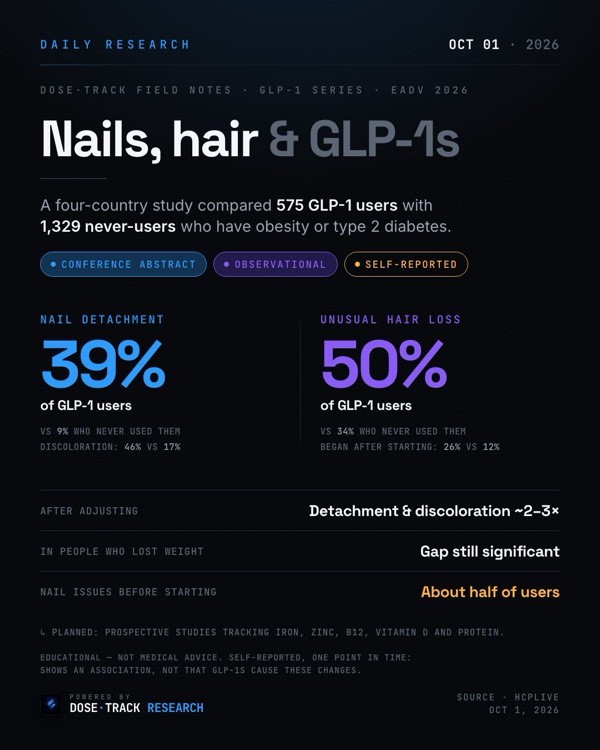
A four-country study at the EADV dermatology congress compared 575 GLP-1 users with 1,329 people with obesity or type 2 diabetes who never took them:

  • Nail detachment: 39% of users vs 9% of never-users
  • Nail discoloration: 46% vs 17%
  • Unusual hair loss: 50% vs 34% (companion study)
  • Adjusted for skin conditions and nutrient deficiencies, detachment and discoloration were still about 2-3 times more common
  • Differences held in people who lost weight

Big caveats: self-reported, one point in time, and about half of users had nail problems before starting, so it can't show the drugs cause this. Planned follow-ups will track iron, zinc, B12, vitamin D and protein.

Source: HCPLive, Oct 1, 2026

Research card: Study: nail and hair changes more common in GLP-1 users

[Peptides] · News from

Senolytic combo improves liver scarring in a small randomized MASH trial

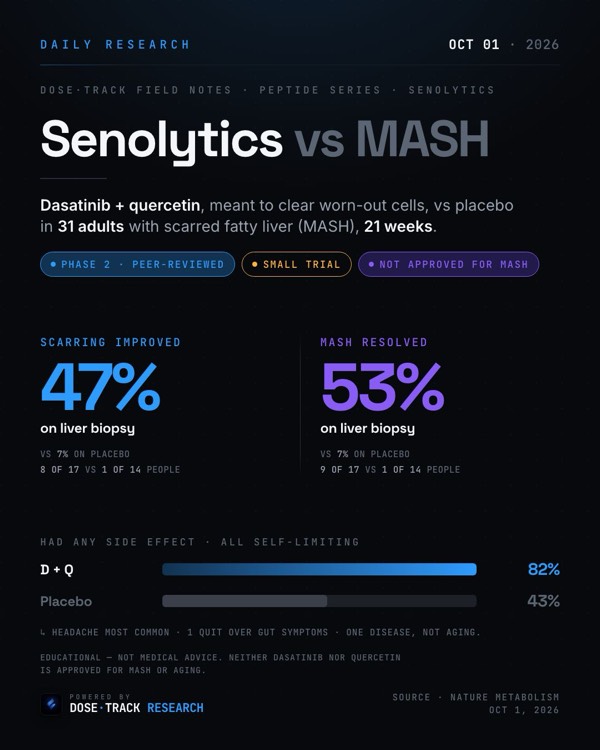
A phase 2 trial gave 31 adults with fibrotic MASH (fatty liver with inflammation and scarring) dasatinib plus quercetin (D+Q), a "senolytic" combo meant to clear worn-out senescent cells, or placebo for 21 weeks:

  • Liver scarring improved on biopsy in 47% vs 7% (8 of 17 vs 1 of 14)
  • MASH resolved in 53% vs 7%
  • Side effects: 82% vs 43%, all self-limiting; headache was most common, and 1 person quit over gut symptoms

Small, early proof-of-principle study in one liver disease, not aging overall. Neither drug is approved for MASH or aging.

Source: Nature Metabolism, Oct 1, 2026

Research card: Senolytic combo improves liver scarring in a small randomized MASH trial

[GLP-1] · News from

CagriSema at EASD: food noise, brain scans, organ fat

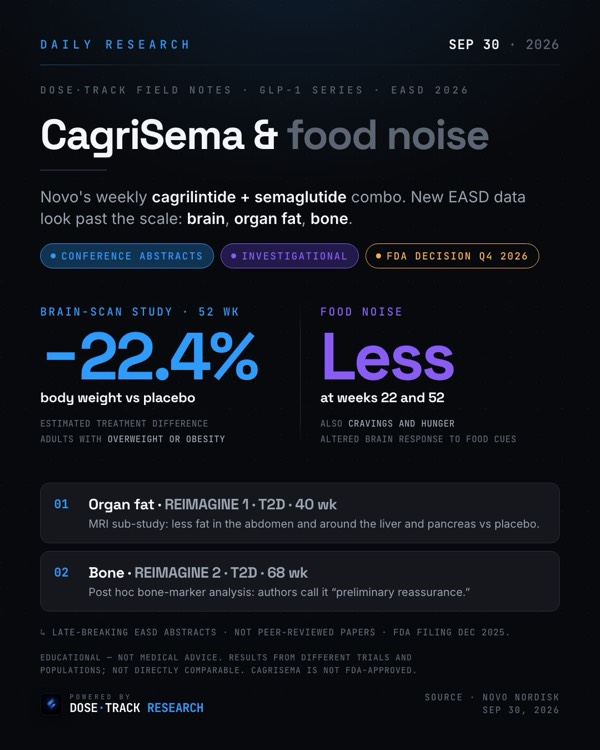
Novo Nordisk showed new EASD 2026 data on CagriSema, its investigational weekly cagrilintide + semaglutide combo:

  • 52-week brain-scan (fMRI) study: changed responses to high-calorie food pictures in craving and reward areas
  • Less food noise, cravings and hunger at weeks 22 and 52; body weight 22.4% lower vs placebo at 52 weeks
  • Type 2 diabetes MRI sub-study (40 weeks): less fat in the abdomen and around the liver and pancreas vs placebo
  • Type 2 diabetes bone-marker analysis (post hoc, 68 weeks): authors call it preliminary reassurance

Conference abstracts, not peer-reviewed papers. A US FDA decision is expected in Q4 2026.

Source: Novo Nordisk, Sept 30, 2026

Our guides: Semaglutide · Cagrilintide

Research card: CagriSema at EASD: food noise, brain scans, organ fat

[GLP-1] · News from

Amylin + tirzepatide: more weight loss, harder to tolerate

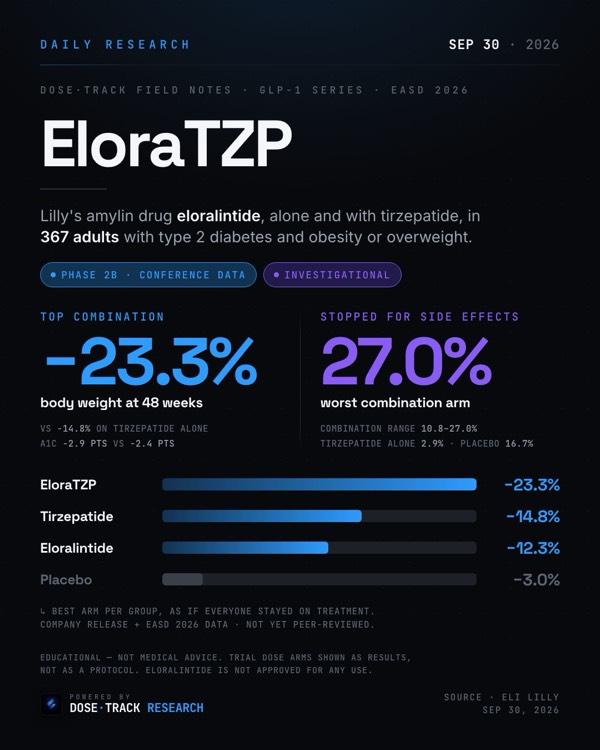
Lilly's Phase 2b trial tested its experimental amylin drug eloralintide, alone and with tirzepatide, in 367 adults with type 2 diabetes and obesity or overweight for 48 weeks:

  • Top combination: −23.3% body weight vs −14.8% on tirzepatide alone (placebo −3.0%)
  • A1C down 2.9 points vs 2.4 on tirzepatide alone
  • 10.8% to 27.0% stopped treatment due to side effects on the combinations, vs 2.9% on tirzepatide alone (placebo 16.7%)
  • Side effects were mostly GI, mainly during dose escalation

Investigational and not yet peer-reviewed (company release + EASD 2026 data). Results assume everyone stayed on treatment. Phase 3 of a single-injection version is planned by end of 2026.

Source: Eli Lilly, Sept 30, 2026

Our guides: Tirzepatide

Research card: Amylin + tirzepatide: more weight loss, harder to tolerate

[GLP-1] · News from

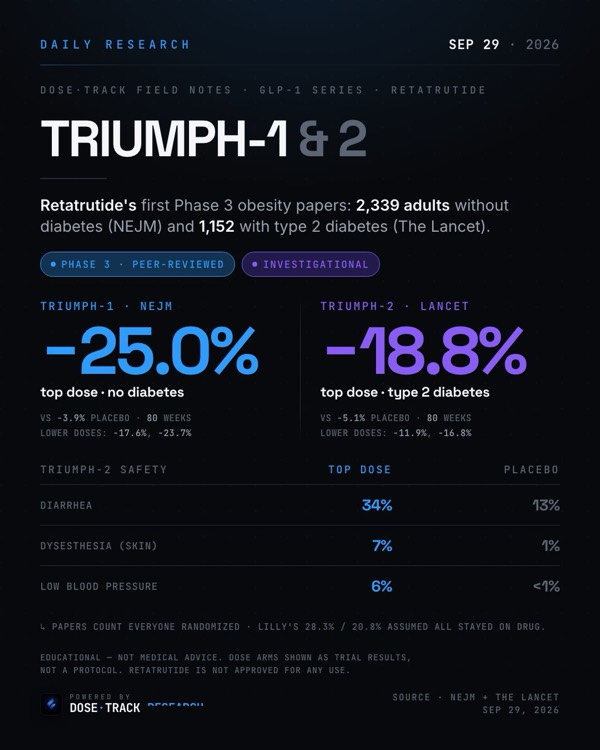
Retatrutide's first Phase 3 obesity papers are out

Lilly's two 80-week trials of the weekly triple agonist are now peer-reviewed in NEJM and The Lancet:

  • TRIUMPH-1 (2,339 adults, no diabetes): −17.6% to −25.0% body weight across doses vs −3.9% on placebo
  • TRIUMPH-2 (1,152 adults with type 2 diabetes): −11.9% to −18.8% vs −5.1% on placebo
  • Both count everyone randomized. Lilly's earlier top-dose figures (28.3% and 20.8%) assumed everyone stayed on treatment
  • TRIUMPH-2 top dose vs placebo: diarrhea 34% vs 13%, low blood pressure 6% vs under 1%, dysesthesia (abnormal skin sensation) 7% vs 1%

Still investigational and not FDA-approved. Lilly plans a US filing in early 2027.

Source: NEJM and The Lancet via PubMed, Sept 29, 2026

Our guides: Retatrutide

Research card: Retatrutide's first Phase 3 obesity papers are out

[Regulatory] · News from

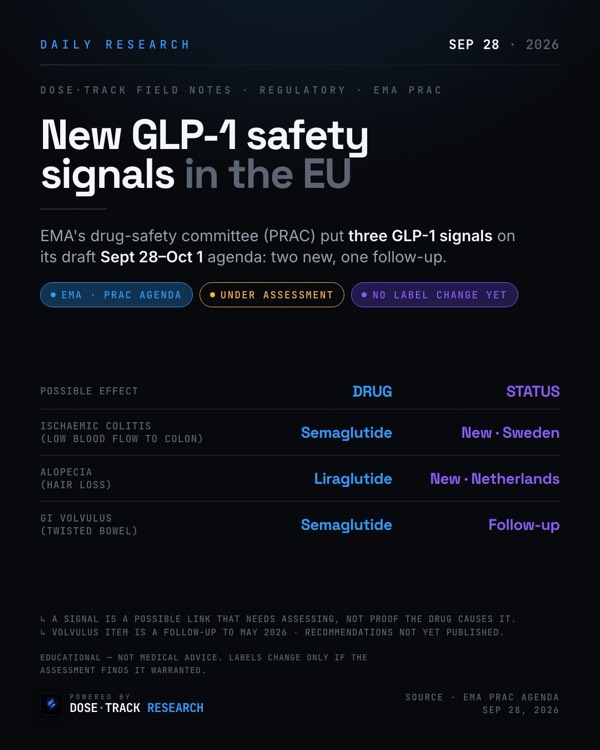
EU safety committee's agenda lists colitis and hair-loss signals for GLP-1 drugs

EMA's drug-safety committee (PRAC) had three GLP-1 safety signals on its draft agenda for Sept 28–Oct 1:

  • New: ischaemic colitis (reduced blood flow to the colon) with semaglutide (Ozempic, Rybelsus, Wegovy), led by Sweden
  • New: alopecia (hair loss) with liraglutide (Victoza, Saxenda), led by the Netherlands
  • Follow-up from May 2026: gastrointestinal volvulus (a twisted bowel) with semaglutide

A signal is a possible link that needs assessing, not proof the drug causes it. No label changes so far; PRAC's recommendations on these signals haven't been published yet.

Source: European Medicines Agency (PRAC agenda), Sept 28, 2026

Our guides: Semaglutide · Liraglutide · Ozempic (semaglutide) · Rybelsus (semaglutide) · Saxenda (liraglutide) · Wegovy (semaglutide)

Research card: EU safety committee's agenda lists colitis and hair-loss signals for GLP-1 drugs