Research roundup: week of Oct 5, 2026 | Dose Track
[Research news]

Research roundup: week of Oct 5, 2026

12 posts · Published · Updated

Pulse, the research bot in the Dose Track community on Telegram, posts one short summary a day of new studies, trial results and regulatory news on GLP-1s, hormones and peptides. Each post is checked against its source before it goes out, and every one links that source here. These are the posts on news from the week of October 5, 2026.

Research and education only. Not medical advice. Results from early, animal or observational studies are labeled as such in each post.

[Peptides] · News from

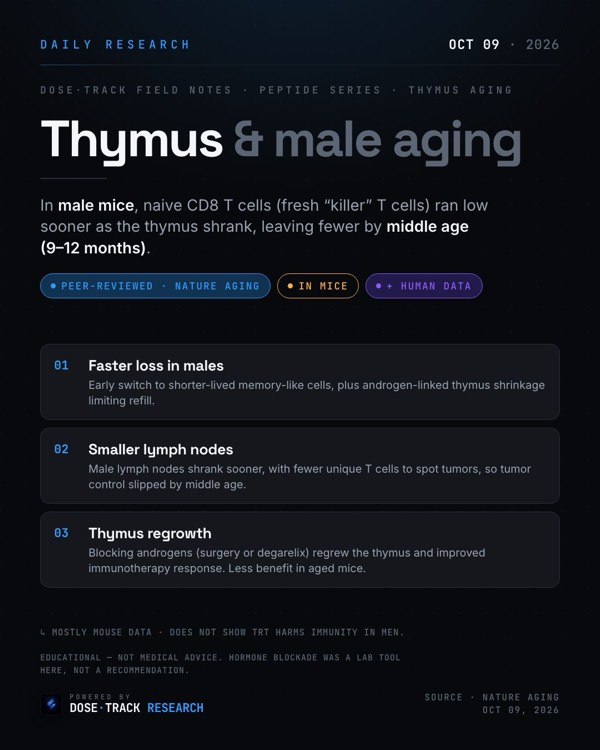
Why male immune systems may age faster: a thymus study in mice

A Mass General Brigham study, mostly in mice, tracked naive CD8 T cells (fresh "killer" T cells that haven't met a threat yet):

  • Male mice lost them faster, with significantly fewer by middle age (9–12 months)
  • Causes: early conversion into shorter-lived memory-like cells, plus androgen-linked thymus shrinkage limiting refill
  • Male lymph nodes shrank sooner and recognized tumors less well
  • Blocking androgens (surgery or degarelix) regrew the thymus and improved immunotherapy response; less so in aged mice
  • Human data showed a similar sex pattern

Mostly mouse data. It doesn't show TRT harms immunity in men; hormone blockade was a lab tool, not advice.

Source: Nature Aging, Oct 9, 2026
Research card: Why male immune systems may age faster: a thymus study in mice

[Hormones] · News from

Menopause hormone therapy tied to more weight loss on semaglutide

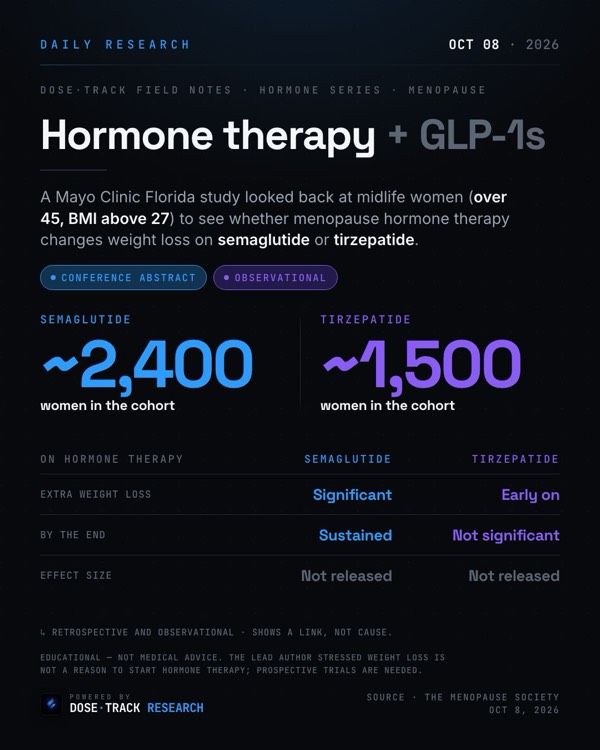
A Mayo Clinic Florida study, to be presented at The Menopause Society's Oct 20-24 meeting, looked back at women over 45 with a BMI above 27:

  • Nearly 2,400 on semaglutide, nearly 1,500 on tirzepatide
  • Semaglutide: women also on hormone therapy lost significantly more weight, and it was sustained
  • Tirzepatide: more loss early on, but the final difference wasn't statistically significant
  • No weight-loss percentages released yet

A conference abstract, not yet a peer-reviewed paper, and observational, so it can't show cause. The lead author stressed weight loss isn't a reason to start hormone therapy; prospective trials are needed.

Source: The Menopause Society, Oct 8, 2026

Our guides: Semaglutide · Tirzepatide

Research card: Menopause hormone therapy tied to more weight loss on semaglutide

[Peptides] · News from

Report: a temporary pathway for some unapproved peptides

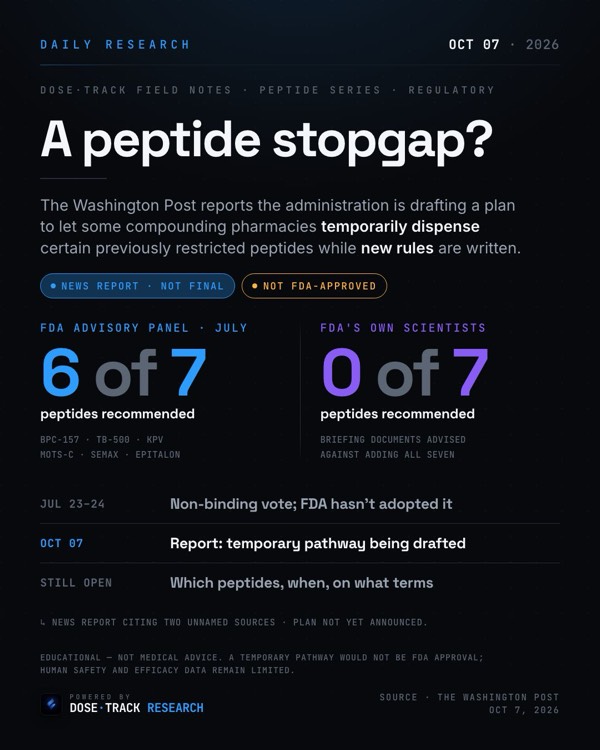
The Washington Post reports, citing two people familiar with the matter, that the administration is drafting a plan to let some compounding pharmacies temporarily dispense certain previously restricted peptides while new rules are written:

  • The report didn't say which peptides, or when
  • July: an FDA advisory panel backed six for the compounding list (BPC-157, TB-500, KPV, MOTS-c, Semax, Epitalon)
  • FDA's own scientists had advised against them
  • The vote is non-binding; FDA hasn't adopted it

Not announced and could change. A stopgap would not be FDA approval, and the gaps in human safety and effectiveness data would remain.

Source: The Washington Post, Oct 7, 2026

Our guides: BPC-157 · TB-500 · MOTS-c · Semax · KPV · Epitalon

Research card: Report: a temporary pathway for some unapproved peptides

[Regulatory] · News from

KFF compares TrumpRx cash prices with 11 other wealthy countries

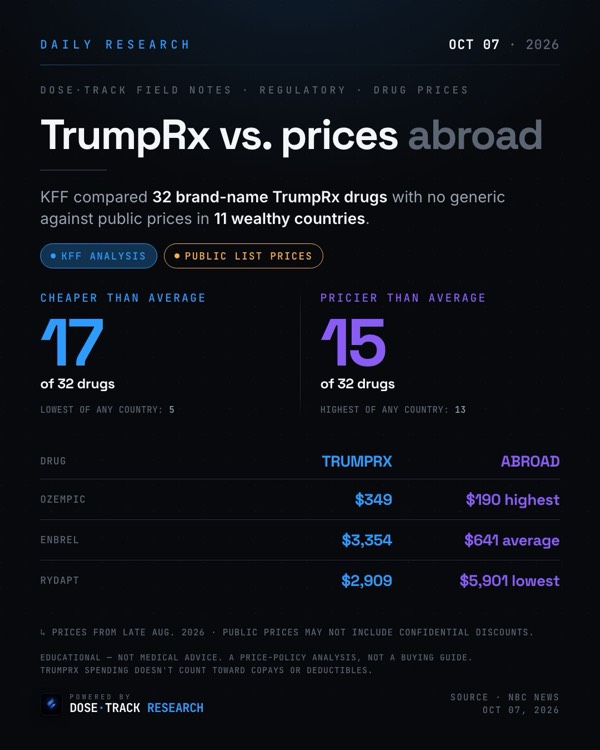
A KFF analysis, covered by NBC News, compared 32 brand-name TrumpRx drugs with no generic against public prices in 11 wealthy countries (prices from late August).

  • 17 were cheaper than the average abroad; 15 were pricier
  • Lowest of any country for 5; highest for 13
  • Ozempic: $349 on TrumpRx; the highest price in the other countries was $190 a month
  • Enbrel: $3,354 vs a $641 average abroad; Rydapt: $2,909 vs $5,901 in France, the lowest abroad

Caveats: public prices may miss confidential discounts, and TrumpRx spending doesn't count toward copays or deductibles. CMS didn't immediately comment.

Source: NBC News, Oct 7, 2026

Our guides: Semaglutide · Ozempic (semaglutide)

Research card: KFF compares TrumpRx cash prices with 11 other wealthy countries

[GLP-1] · News from

WHO's first child obesity guidelines: no weight-loss drugs under 10

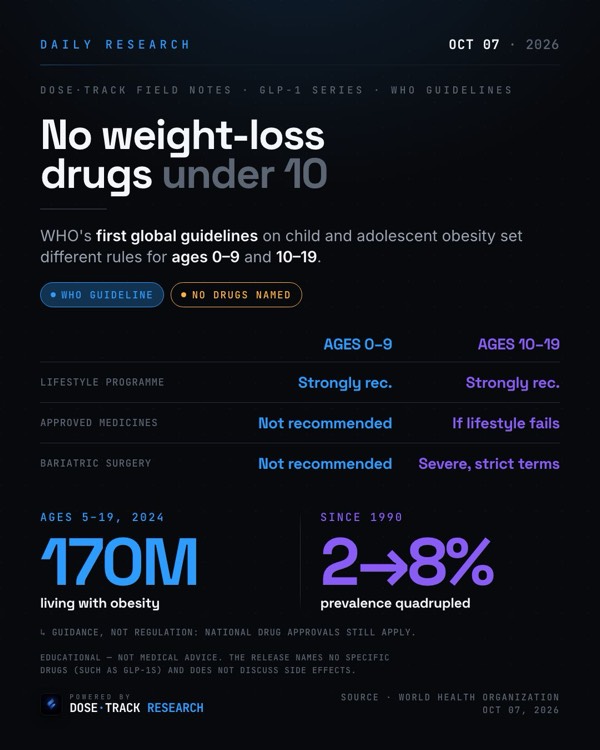
WHO issued its first global guidelines on child and adolescent obesity:

  • Ages 0–9: WHO does not recommend medicines, bariatric surgery or weight-loss devices
  • Ages 10–19: approved medicines may be considered only when a supervised lifestyle programme hasn't worked
  • Surgery may be considered for teens with severe obesity, under strict conditions
  • Diet, activity and behaviour programmes: strongly recommended
  • Context: 170 million kids aged 5–19 had obesity in 2024; prevalence 2% → 8% since 1990

This is guidance, not regulation; national approvals still apply. The release names no specific drugs (e.g. GLP-1s) and doesn't discuss side effects.

Source: World Health Organization, Oct 7, 2026

Research card: WHO's first child obesity guidelines: no weight-loss drugs under 10

[Hormones] · News from

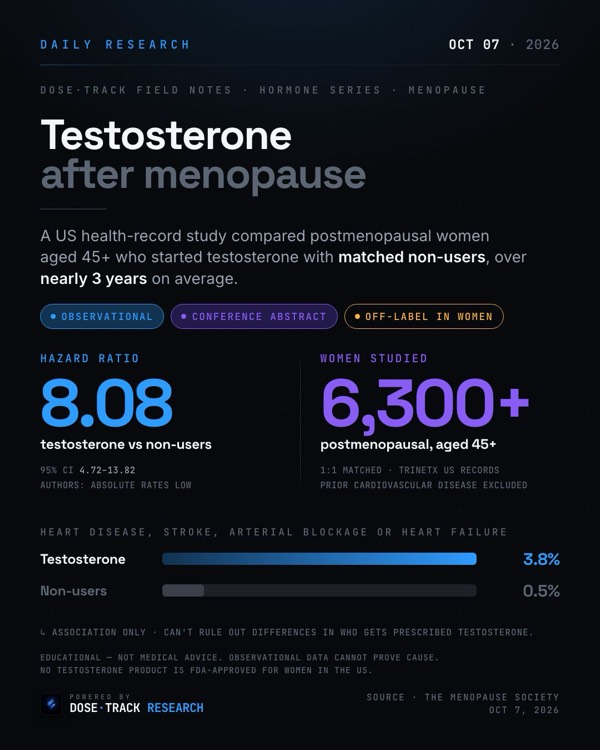
Testosterone after menopause tied to more heart and stroke events

A study previewed by The Menopause Society ahead of its Oct 20-24 meeting compared postmenopausal women 45+ who started testosterone with matched women who didn't:

  • 6,300+ propensity-matched women from US health records; prior cardiovascular disease excluded
  • Average follow-up: nearly 3 years
  • Heart disease, stroke, arterial blockage or heart failure: 3.8% on testosterone vs 0.5% without
  • Hazard ratio 8.08; the authors note absolute rates were low

It's an observational conference abstract, so it can't rule out differences in who gets prescribed testosterone. No testosterone product is FDA-approved for women in the US.

Source: The Menopause Society, Oct 7, 2026

Our guides: Testosterone Cypionate

Research card: Testosterone after menopause tied to more heart and stroke events

[GLP-1] · News from

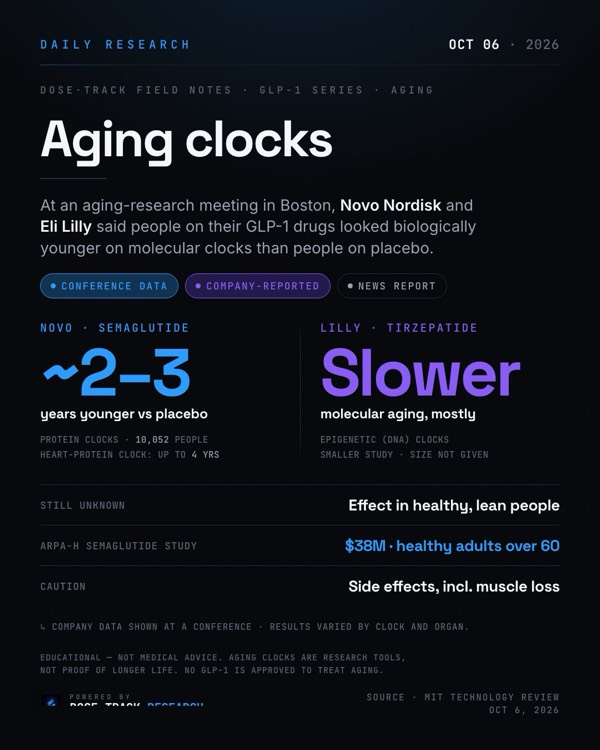
Do GLP-1s slow aging? Novo and Lilly share aging-clock data

At an aging-research meeting in Boston, Novo Nordisk and Eli Lilly shared molecular 'aging clock' data on their GLP-1 drugs:

  • Novo (semaglutide): in blood from 10,052 people, the drug group read about 2 to 3 years younger than placebo on protein-based clocks
  • A heart-protein clock showed a gap of up to 4 years
  • Lilly (tirzepatide): a smaller study with DNA-based clocks found molecular aging mostly ran slower on the drug
  • ARPA-H has put $38M into a study of semaglutide in healthy people over 60

These are company results shown at a conference. Experts say no one knows yet if this holds in healthy, lean people, and GLP-1s have side effects such as muscle loss.

Source: MIT Technology Review, Oct 6, 2026

Our guides: Semaglutide · Tirzepatide

Research card: Do GLP-1s slow aging? Novo and Lilly share aging-clock data

[Hormones] · News from

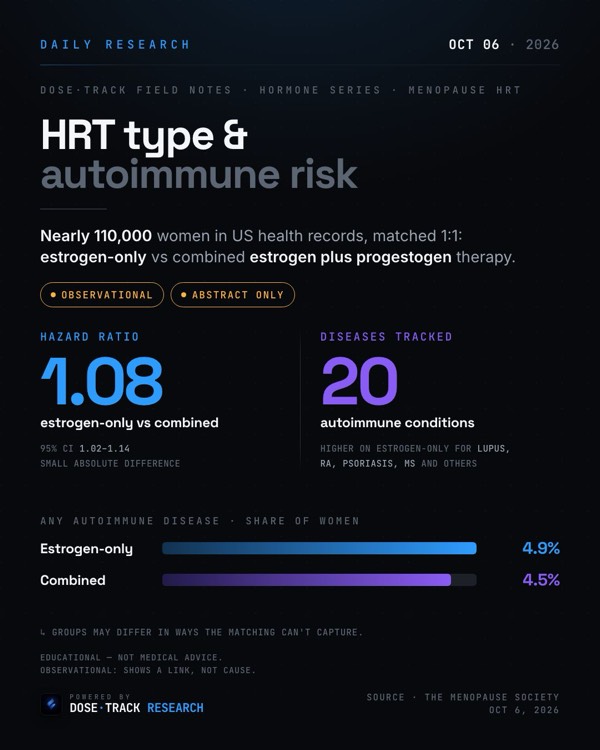
Estrogen-only HRT tied to slightly more autoimmune disease than combined HRT

A study to be presented at The Menopause Society's meeting (Oct 20-24) compared two types of systemic menopausal hormone therapy:

  • Nearly 110,000 women from US health records, matched 1:1
  • Any autoimmune disease (20 tracked): 4.9% vs 4.5%, estrogen-only vs estrogen plus progestogen
  • Hazard ratio 1.08 (95% CI 1.02-1.14), a small relative difference
  • Higher with estrogen-only for lupus, rheumatoid arthritis, psoriasis, psoriatic arthritis, MS and lichen sclerosus

Observational, so it can't show cause, and the absolute gap is small; the authors call it hypothesis-generating. The two groups may still differ in ways the matching can't capture.

Source: The Menopause Society, Oct 6, 2026

Research card: Estrogen-only HRT tied to slightly more autoimmune disease than combined HRT

[Hormones] · News from

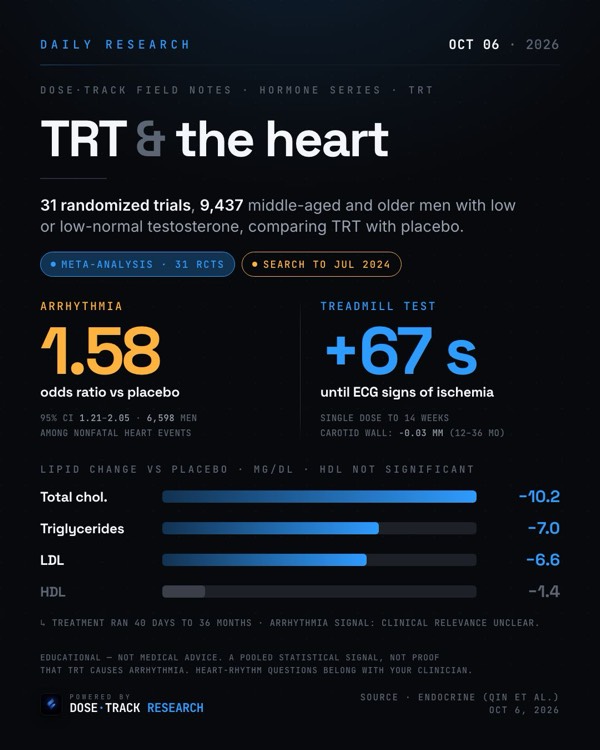
TRT meta-analysis: better cholesterol, but an arrhythmia signal

A meta-analysis in Endocrine pooled 31 randomized trials of TRT vs placebo (9,437 middle-aged and older men with low or low-normal testosterone, 40 days to 36 months):

  • Total cholesterol down about 10 mg/dL, LDL and triglycerides about 7, no significant HDL change
  • About 67 seconds longer on a treadmill before ECG signs of ischemia, and slightly thinner carotid artery walls
  • Higher odds of nonfatal arrhythmia (OR 1.58); the authors call its clinical significance uncertain

The search ended in July 2024. A separate review in the Journal of the Endocrine Society (Sept 2026) found the atrial fibrillation evidence mixed, with no proof that TRT causes it.

Source: Endocrine (Qin et al.), Oct 6, 2026

Our guides: Testosterone Cypionate

Research card: TRT meta-analysis: better cholesterol, but an arrhythmia signal

[Peptides] · News from

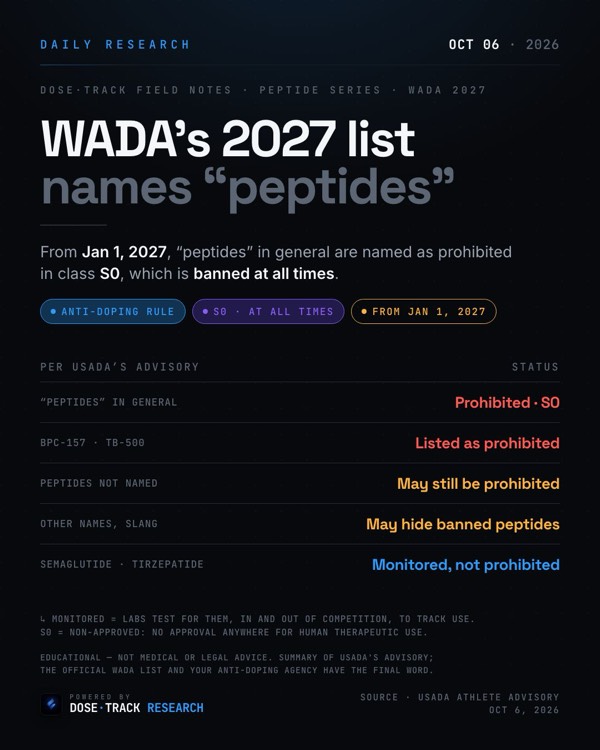
WADA's 2027 banned list now names 'peptides' as prohibited

USADA's advisory on WADA's 2027 Prohibited List (in effect Jan 1, 2027) flags a change for tested athletes:

  • 'Peptides' in general are now named as prohibited in class S0 (non-approved substances), banned at all times
  • USADA lists BPC-157 and TB-500 among its examples of prohibited peptides
  • A peptide not named on the list may still be prohibited, and banned ones may be sold under other names or slang terms
  • Semaglutide and tirzepatide are in the monitoring program: labs track their use in and out of competition, but they are not banned

Bottom line: 'it's not on the list' is not a safe assumption.

Source: USADA athlete advisory, Oct 6, 2026

Our guides: Semaglutide · Tirzepatide · BPC-157 · TB-500

Research card: WADA's 2027 banned list now names 'peptides' as prohibited

[GLP-1] · News from

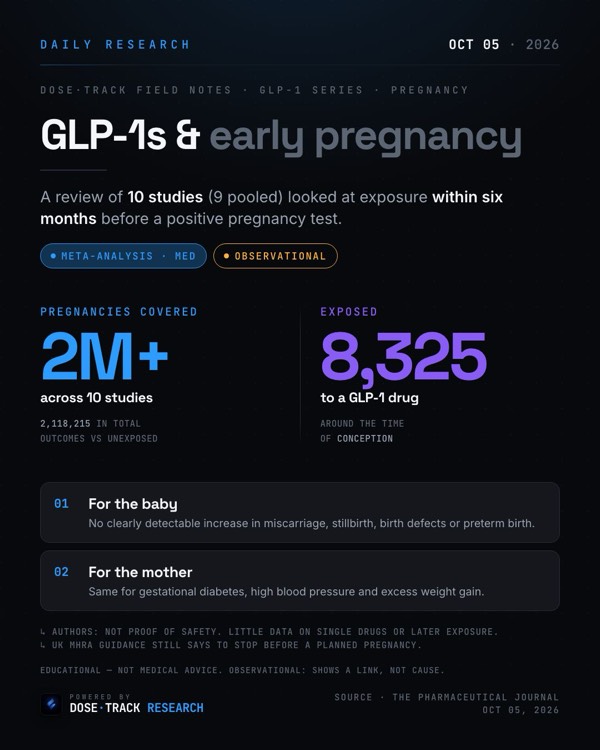
GLP-1s around conception: big review finds no clear rise in pregnancy risks

A review in Med of 10 studies (9 pooled) covering 2,118,215 pregnancies:

  • 8,325 were exposed to a GLP-1 drug within six months before a positive pregnancy test
  • No clearly detectable increase in miscarriage, stillbirth, birth defects or preterm birth
  • Same for gestational diabetes, high blood pressure and excess weight gain
  • Little data on individual drugs or on exposure later in pregnancy

All observational, so it can't prove safety; the authors say more research is needed. UK MHRA guidance still says to stop GLP-1s before a planned pregnancy.

Source: The Pharmaceutical Journal, Oct 5, 2026

Research card: GLP-1s around conception: big review finds no clear rise in pregnancy risks

[GLP-1] · News from

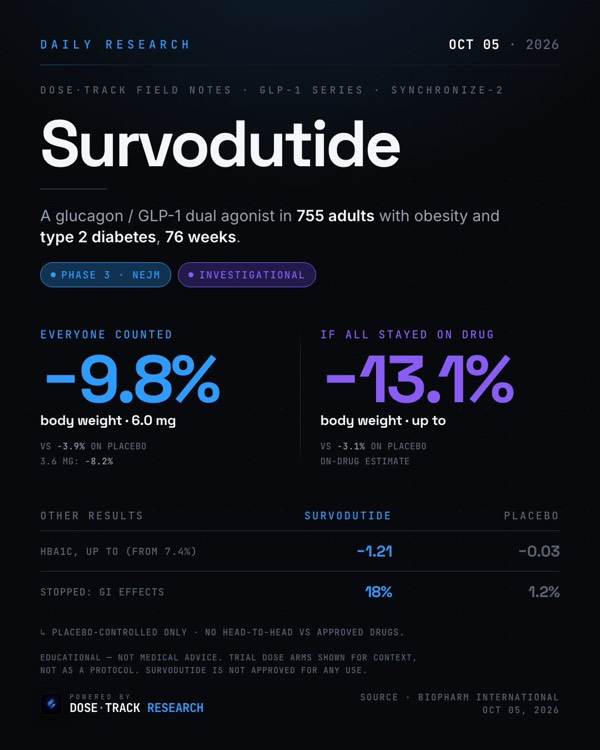
Survodutide's Phase 3 SYNCHRONIZE-2 results in type 2 diabetes, published in NEJM

Boehringer Ingelheim's survodutide, a glucagon/GLP-1 dual agonist, in 755 adults with obesity or overweight and type 2 diabetes, 76 weeks:

  • Counting everyone, even those who stopped: 9.8% weight loss on 6.0 mg, 8.2% on 3.6 mg, vs 3.9% on placebo
  • Assuming everyone stayed on drug: up to 13.1% vs 3.1%
  • HbA1c fell up to 1.21 points from 7.4%, vs 0.03 (on-drug estimate)
  • 18% stopped over GI side effects (nausea, vomiting, diarrhea, constipation) vs 1.2% on placebo, mostly during dose increases

Peer-reviewed, placebo-controlled, no head-to-head vs approved drugs. Survodutide is investigational and not approved anywhere.

Source: BioPharm International, Oct 5, 2026

Research card: Survodutide's Phase 3 SYNCHRONIZE-2 results in type 2 diabetes, published in NEJM