Research roundup: week of Oct 12, 2026 | Dose Track
[Research news]

Research roundup: week of Oct 12, 2026

4 posts · Published · Updated

Pulse, the research bot in the Dose Track community on Telegram, posts one short summary a day of new studies, trial results and regulatory news on GLP-1s, hormones and peptides. Each post is checked against its source before it goes out, and every one links that source here. These are the posts on news from the week of October 12, 2026.

Research and education only. Not medical advice. Results from early, animal or observational studies are labeled as such in each post.

[Regulatory] · News from

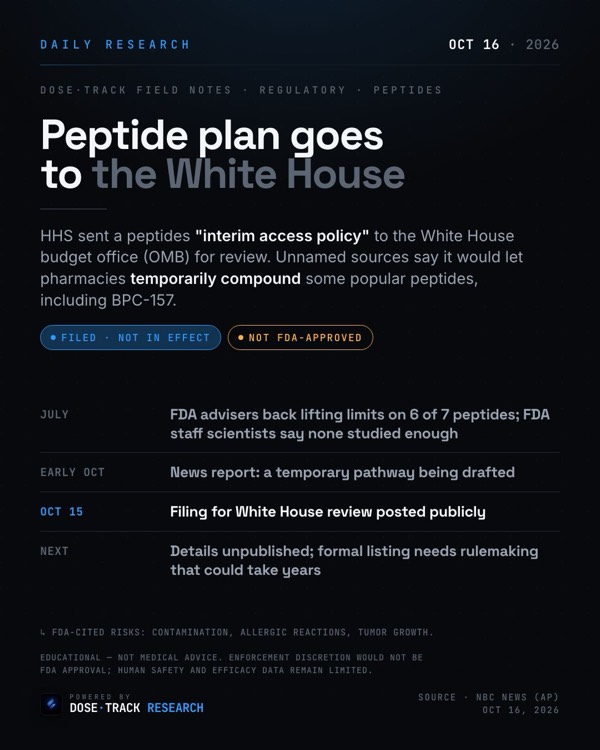
HHS sends a peptide "interim access policy" to the White House for review

New since an early-October news report: HHS formally sent the policy to the White House budget office (OMB) for review.

  • No details published; two unnamed sources say it would let pharmacies temporarily compound some popular peptides, incl. BPC-157
  • The route: "enforcement discretion", FDA choosing not to enforce some rules
  • July: FDA advisers backed lifting limits on 6 of 7 peptides; FDA staff scientists said none was studied enough to establish safety and effectiveness
  • FDA-cited risks: contamination, allergic reactions, tumor growth

Not in effect. A formal listing would need rulemaking that could take years; none of this is FDA approval.

Source: NBC News (AP), Oct 16, 2026

Our guides: BPC-157
Research card: HHS sends a peptide "interim access policy" to the White House for review

[GLP-1] · News from

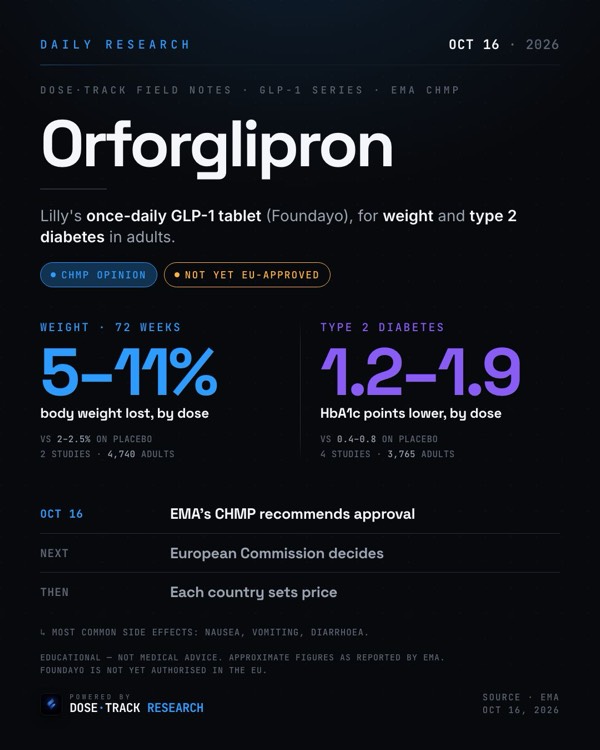
EU regulator backs Lilly's once-daily GLP-1 pill orforglipron (Foundayo)

EMA's committee (CHMP) recommended EU approval of Foundayo (orforglipron), a once-daily GLP-1 tablet, for weight management and type 2 diabetes in adults:

  • Weight: 2 studies, 4,740 adults; about 5% to 11% of body weight lost at 72 weeks by dose, vs about 2% to 2.5% on placebo
  • Diabetes: 4 studies, 3,765 adults; HbA1c (a blood-sugar marker) fell about 1.2 to 1.9 points, vs 0.4 to 0.8 on placebo and 1.2 to 1.5 on oral semaglutide
  • Most common side effects: nausea, vomiting and diarrhoea, more often while the dose was being raised

Not approved yet: the European Commission decides next, then each country sets price and reimbursement.

Source: European Medicines Agency, Oct 16, 2026

Our guides: Semaglutide · Foundayo (orforglipron)

Research card: EU regulator backs Lilly's once-daily GLP-1 pill orforglipron (Foundayo)

[Hormones] · News from

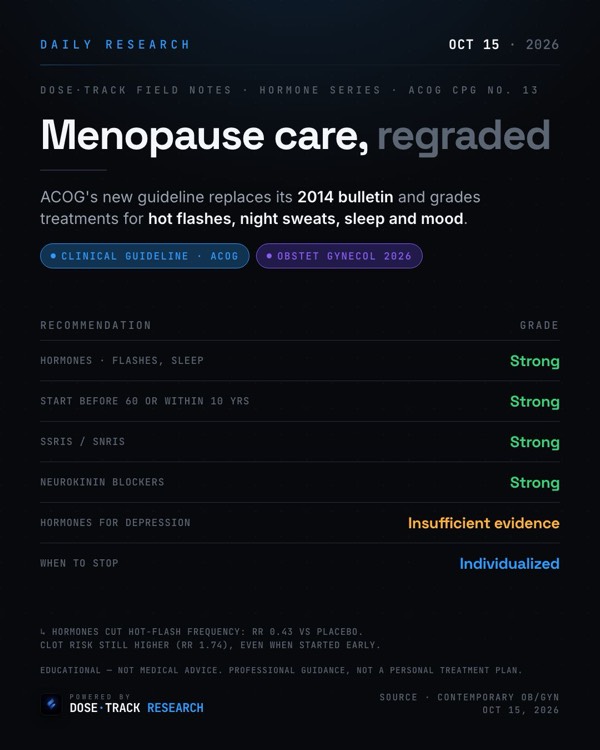
ACOG menopause guideline strongly backs hormone therapy for hot flashes

ACOG Clinical Practice Guideline No. 13 replaces its 2014 bulletin on menopause symptoms:

  • Strong: systemic hormone therapy (estrogen, plus a progestogen with a uterus) for hot flashes, night sweats and related sleep loss
  • Cited meta-analysis: hot-flash frequency RR 0.43 vs placebo
  • Strong: starting before 60 or within 10 years of menopause
  • Strong non-hormone options: SSRIs/SNRIs, neurokinin blockers (fezolinetant, elinzanetant)
  • Depression: insufficient evidence for or against hormones
  • Stopping: individualized

Early starters still had higher clot risk (RR 1.74). Guidance, not personal advice.

Source: Contemporary OB/GYN, Oct 15, 2026

Research card: ACOG menopause guideline strongly backs hormone therapy for hot flashes

[Hormones] · News from

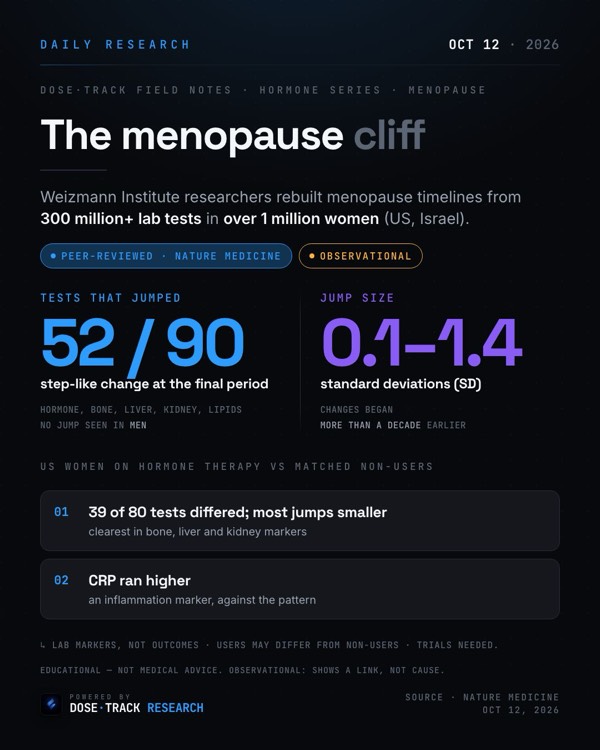
Huge lab-data study finds a 'cliff' at menopause, smaller with hormone therapy

A Weizmann Institute team rebuilt menopause timelines from more than 300 million routine lab tests in over 1 million women (US and Israel):

  • 52 of 90 tests jumped step-like at the final period: hormone, bone, liver, kidney and lipid markers
  • Jumps of 0.1 to 1.4 SD (standard deviations); absent in men
  • Changes began more than a decade earlier
  • US women on hormone therapy: 39 of 80 tests differed, most jumps smaller, but CRP (inflammation) was higher

Observational lab data, not health outcomes. Therapy users may differ from non-users; the authors call for randomized trials.

Source: Nature Medicine, Oct 12, 2026

Research card: Huge lab-data study finds a 'cliff' at menopause, smaller with hormone therapy